How Many Countries Are in Europe? Complete List (2026)
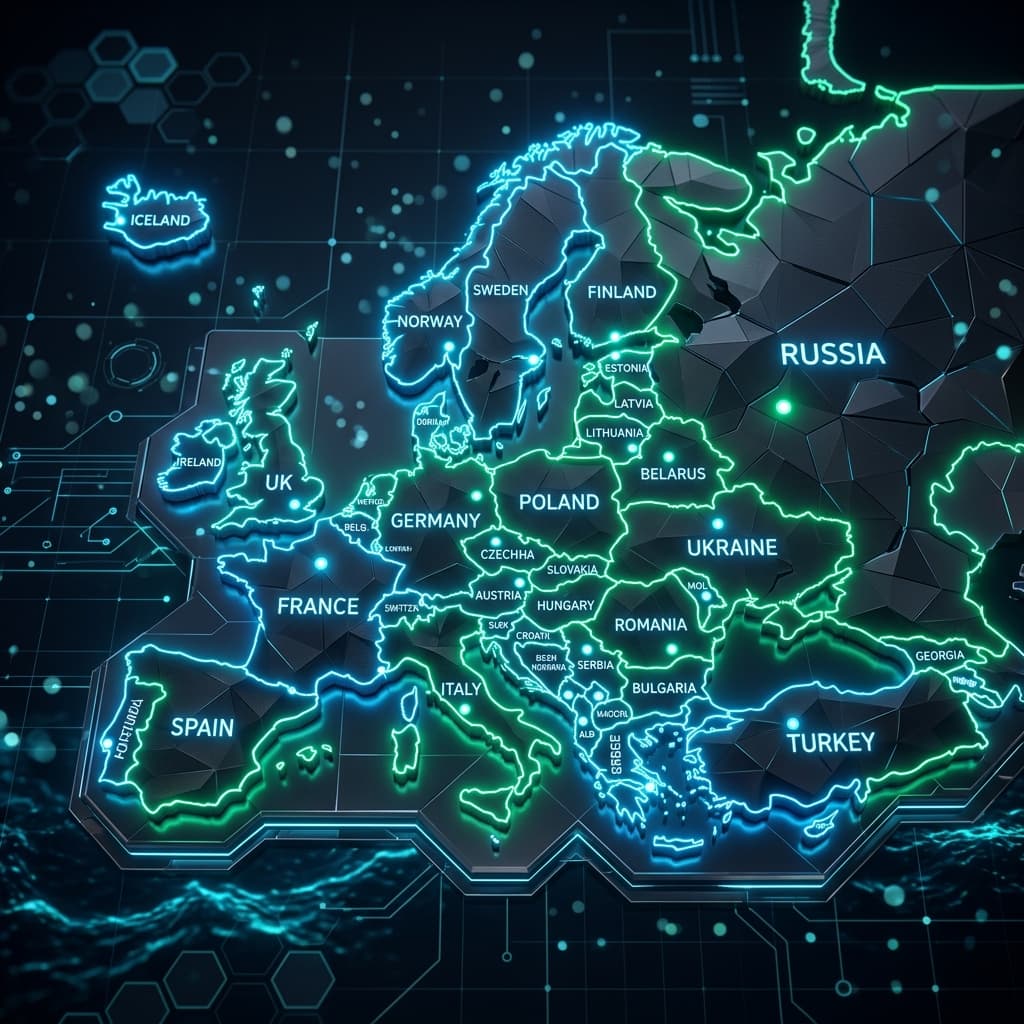
There are 44 countries in Europe according to the United Nations geoscheme. However, depending on how you define Europe's boundaries, the number can go as high as 50 or even 51.
The confusion comes down to one problem: Europe does not have a clean eastern border. It shares a continuous landmass with Asia, and several countries — Russia, Turkey, Georgia, Armenia, Azerbaijan, and Kazakhstan — straddle both continents. Whether you count them as European changes the total dramatically.
In this guide, we break down every count, list all European countries with their capitals, explain the EU vs Schengen vs Eurozone differences, and cover the microstates, transcontinental debates, and surprising facts that make European geography so fascinating.
At World Guesser, our team builds geography games and quizzes covering every continent. Europe is one of the trickiest regions in our daily challenge because so many countries are packed into a small area with confusing borders. That experience shaped this guide.
The Short Answer: 44 Countries
The United Nations geoscheme lists 44 sovereign states with their capitals located on the European continent. This is the number used by most official sources, educational institutions, and geography textbooks.
However, you will see different numbers depending on the source:
| Count | Definition | What It Includes |
|---|---|---|
| 44 | UN geoscheme (standard) | Sovereign states with capitals in Europe |
| 45 | UN + Kosovo | 44 + Kosovo (partially recognized, declared independence in 2008) |
| 46 | + Cyprus | 45 + Cyprus (geographically Asian, but EU member and culturally European) |
| 49-50 | Broad geographic | + Turkey, Georgia, Armenia, Azerbaijan (transcontinental or Caucasus states) |
| 51 | Broadest definition | + Kazakhstan (small sliver west of the Ural River) |
So which number is "correct"? It depends on whether you define Europe by geography, politics, or culture. For this guide, we use 44 as the baseline and clearly note every country that pushes the total higher.
Why do different sources say 44, 49, 50, or 51 countries in Europe?
The root cause is that Europe and Asia are not separated by an ocean. They share one continuous landmass called Eurasia. The conventional boundary runs along the Ural Mountains in Russia, down through the Caspian Sea, and along the Caucasus Mountains. But this line is a human convention, not a natural barrier — and reasonable people draw it in different places.
Turkey is the classic example. Only about 3% of Turkey's land area sits in Europe (the region called East Thrace, including the European side of Istanbul). Is that enough to call it a European country? The UN says no. UEFA says yes — Turkey's football teams compete in European tournaments. Eurovision says yes — Turkey has competed in the song contest. There is no single right answer.
If you want to learn more about how countries are counted globally, see our guide on how many countries are in the world.
Complete List of All European Countries and Capitals
Here is the list of 44 European countries recognized under the UN geoscheme (plus Kosovo, Vatican City, and the transcontinental states that frequently appear on European lists). Each country includes its capital, region, EU membership status, and approximate population.
Core European Countries (UN Geoscheme + Recognized States)
| # | Country | Capital | Region | EU Member | Population (est.) |
|---|---|---|---|---|---|
| 1 | Albania | Tirana | Southern | No (candidate) | 2.8M |
| 2 | Andorra | Andorra la Vella | Southern | No | 80K |
| 3 | Austria | Vienna | Western | Yes | 9.1M |
| 4 | Belarus | Minsk | Eastern | No | 9.2M |
| 5 | Belgium | Brussels | Western | Yes | 11.7M |
| 6 | Bosnia and Herzegovina | Sarajevo | Southern | No (candidate) | 3.2M |
| 7 | Bulgaria | Sofia | Eastern | Yes | 6.5M |
| 8 | Croatia | Zagreb | Southern | Yes | 3.9M |
| 9 | Czechia | Prague | Eastern | Yes | 10.8M |
| 10 | Denmark | Copenhagen | Northern | Yes | 5.9M |
| 11 | Estonia | Tallinn | Northern | Yes | 1.3M |
| 12 | Finland | Helsinki | Northern | Yes | 5.6M |
| 13 | France | Paris | Western | Yes | 66.7M |
| 14 | Germany | Berlin | Western | Yes | 84.5M |
| 15 | Greece | Athens | Southern | Yes | 10.3M |
| 16 | Hungary | Budapest | Eastern | Yes | 9.6M |
| 17 | Iceland | Reykjavik | Northern | No | 390K |
| 18 | Ireland | Dublin | Northern | Yes | 5.1M |
| 19 | Italy | Rome | Southern | Yes | 58.9M |
| 20 | Kosovo | Pristina | Southern | No (partially recognized) | 1.8M |
| 21 | Latvia | Riga | Northern | Yes | 1.8M |
| 22 | Liechtenstein | Vaduz | Western | No | 40K |
| 23 | Lithuania | Vilnius | Northern | Yes | 2.8M |
| 24 | Luxembourg | Luxembourg City | Western | Yes | 680K |
| 25 | Malta | Valletta | Southern | Yes | 520K |
| 26 | Moldova | Chișinău | Eastern | No (candidate) | 2.6M |
| 27 | Monaco | Monaco | Western | No | 38K |
| 28 | Montenegro | Podgorica | Southern | No (candidate) | 620K |
| 29 | Netherlands | Amsterdam | Western | Yes | 17.8M |
| 30 | North Macedonia | Skopje | Southern | No (candidate) | 1.8M |
| 31 | Norway | Oslo | Northern | No | 5.5M |
| 32 | Poland | Warsaw | Eastern | Yes | 37.7M |
| 33 | Portugal | Lisbon | Southern | Yes | 10.3M |
| 34 | Romania | Bucharest | Eastern | Yes | 19.0M |
| 35 | Russia | Moscow | Eastern | No | 144M (total) |
| 36 | San Marino | San Marino | Southern | No | 35K |
| 37 | Serbia | Belgrade | Southern | No (candidate) | 6.6M |
| 38 | Slovakia | Bratislava | Eastern | Yes | 5.4M |
| 39 | Slovenia | Ljubljana | Southern | Yes | 2.1M |
| 40 | Spain | Madrid | Southern | Yes | 47.8M |
| 41 | Sweden | Stockholm | Northern | Yes | 10.5M |
| 42 | Switzerland | Bern | Western | No | 8.8M |
| 43 | Ukraine | Kyiv | Eastern | No (candidate) | 37M (est.) |
| 44 | United Kingdom | London | Northern | No (left 2020) | 69.6M |
| 45 | Vatican City | Vatican City | Southern | No | ~800 |
Additional Countries Included on Some European Lists
| Country | Capital | Why It's Debated |
|---|---|---|
| Cyprus | Nicosia | Geographically in Asia (eastern Mediterranean), but EU member and culturally European |
| Turkey | Ankara | Only 3% of territory in Europe (East Thrace); rest is in Asia |
| Georgia | Tbilisi | South of Caucasus; member of Council of Europe and UEFA |
| Armenia | Yerevan | Geographically Asian; culturally and historically tied to Europe |
| Azerbaijan | Baku | South of Caucasus; competes in Eurovision and UEFA |
| Kazakhstan | Astana | Small western sliver is in Europe; included only in broadest definitions |
For the full list of all 195 countries worldwide with their capitals, see our complete countries and capitals list.
European Countries by Region
Europe's countries are commonly divided into four main regions. Learning them by region is one of the most effective ways to study for geography quizzes because it breaks a large list into smaller, more manageable groups.
Northern Europe — 10 Countries
DENMARK, ESTONIA, FINLAND, ICELAND, IRELAND, LATVIA, LITHUANIA, NORWAY, SWEDEN, UNITED KINGDOM.
This region includes Scandinavia (Denmark, Norway, Sweden), the Nordic countries (adding Finland and Iceland), the Baltic states (Estonia, Latvia, Lithuania), and the British Isles (UK and Ireland). Northern Europe is known for high standards of living, strong social safety nets, and some of the happiest populations in the world.
Western Europe — 9 Countries
AUSTRIA, BELGIUM, FRANCE, GERMANY, LIECHTENSTEIN, LUXEMBOURG, MONACO, NETHERLANDS, SWITZERLAND.
Western Europe is the economic core of the continent. Germany and France together account for nearly half of the entire EU economy. This region also contains three of Europe's six microstates: Liechtenstein, Luxembourg, and Monaco. Switzerland and Liechtenstein are notably not EU members, though both participate in the Schengen zone.
Southern Europe — 15 Countries
ALBANIA, ANDORRA, BOSNIA & HERZEGOVINA, CROATIA, GREECE, ITALY, KOSOVO, MALTA, MONTENEGRO, NORTH MACEDONIA, PORTUGAL, SAN MARINO, SERBIA, SLOVENIA, SPAIN, VATICAN CITY.
Southern Europe is the most diverse region on the continent. It includes Mediterranean tourism powerhouses like Spain, Italy, and Greece, alongside the complex patchwork of Balkan states that emerged from the breakup of Yugoslavia in the 1990s. The region also contains three microstates: Andorra, San Marino, and Vatican City.
Eastern Europe — 10 Countries
BELARUS, BULGARIA, CZECHIA, HUNGARY, MOLDOVA, POLAND, ROMANIA, RUSSIA, SLOVAKIA, UKRAINE.
Eastern Europe has transformed dramatically since the fall of communism. Many former Soviet-bloc nations joined the EU and NATO in the 2000s. Poland, Czechia, Hungary, Romania, and Bulgaria are all now EU members. Ukraine and Moldova are active EU candidates. Belarus remains closely aligned with Russia.
The European Union vs Europe — They Are Not the Same Thing
One of the most common geography mistakes is confusing "Europe" with "the European Union." They are not the same thing. Europe is a continent with 44+ countries. The European Union is a political and economic union of 27 member states within that continent.
Here is a quick breakdown of Europe's three main overlapping organizations:
| Organization | Members | What It Does |
|---|---|---|
| European Union (EU) | 27 | Single market, shared laws, common foreign policy. Uses the euro in 20 member states. |
| Schengen Area | 27 | Free travel zone — no passport checks at internal borders. Includes 4 non-EU countries. |
| Eurozone | 20 | Countries that use the euro (€) as their official currency. |
What is the difference between the EU, the Schengen Area, and the Eurozone?
The EU is a political union — member states share laws, trade policies, and institutions like the European Parliament. The Schengen Area is a travel zone — once you enter any Schengen country, you can cross internal borders without showing a passport. The Eurozone is a currency zone — 20 EU countries use the euro as their money.
You can be in one of these groups without being in the others. Switzerland is in Schengen (free travel) but not in the EU and does not use the euro. Croatia joined the EU in 2013 and adopted the euro in 2023. It is a perfect example of how countries can join these organizations at different times.
Is the UK still in the EU?
No. The United Kingdom left the European Union on January 31, 2020, in a process known as Brexit. However, the UK is still a European country — it is part of the continent of Europe, just not part of the EU political union. British citizens now need to follow different visa rules when traveling to EU countries, and the UK is no longer part of the Schengen free-travel zone (though it never was — even as an EU member, the UK did not join Schengen).
As of 2026, there are 8 countries actively seeking EU membership: Albania, Bosnia and Herzegovina, Moldova, Montenegro, North Macedonia, Serbia, Turkey, and Ukraine.
The Transcontinental Debate: Turkey, Russia, and the Caucasus
Several countries sit on the boundary between Europe and Asia, and whether you count them as European changes the total count significantly.
Russia is the clearest case. About 25% of Russia's territory lies west of the Ural Mountains in what is called European Russia. However, this relatively small portion contains roughly 77% of Russia's entire population — about 110 million people. Moscow, St. Petersburg, and all major Russian cities west of the Urals are in Europe. By any standard definition, Russia is counted as a European country, even though the majority of its land area stretches deep into Asia.
Turkey is the most debated. Only about 3% of Turkey's territory is in Europe — the region called East Thrace, on the western side of the Bosphorus strait. This includes the European half of Istanbul, where roughly 14 million people live. Despite this small European footprint, Turkey competes in UEFA football tournaments, participates in Eurovision, and has been a candidate for EU membership since 1999.
Is Turkey a European country? Only 3% of it is actually in Europe.
It depends on who you ask. Geographically, Turkey is overwhelmingly in Asia. Only the small region of East Thrace, including part of Istanbul, sits on the European continent. However, Turkey has deep historical and political ties to Europe — it was the seat of the Ottoman Empire, it is a NATO member, and it has been pursuing EU membership for decades.
The UN geoscheme places Turkey in Western Asia, not Europe. But UEFA, the Council of Europe, and Eurovision all include Turkey. In practice, Turkey occupies a unique position as a bridge between two continents.
Are Georgia, Armenia, and Azerbaijan in Europe or Asia?
This is genuinely debatable. All three countries sit in the Caucasus region, south of the mountain range that traditionally marks one section of the Europe-Asia boundary. Geographically, they are usually classified as part of Western Asia.
However, all three are members of the Council of Europe. Georgia and Azerbaijan compete in UEFA football tournaments. All three have participated in Eurovision. Culturally and historically, Georgia and Armenia have strong ties to European civilization — Armenia was the first country to adopt Christianity as a state religion, in 301 AD.
Most standard definitions of Europe exclude the Caucasus countries, which is why the core count stays at 44. But if you include them plus Turkey, Cyprus, and Kazakhstan, the total can reach 50 or 51.
Is Cyprus in Europe or Asia?
Cyprus is an interesting edge case. Geographically, it is an island in the eastern Mediterranean Sea, closer to Turkey and Syria than to any European mainland. By strict geographic standards, Cyprus belongs to Asia.
However, Cyprus has been an EU member since 2004. Its population is predominantly Greek-speaking and culturally Mediterranean-European. It uses the euro. Its political institutions are modeled on European systems. In every meaningful political and cultural sense, Cyprus is European.
Most lists of European countries include Cyprus even though its geography says otherwise. If you use a purely geographic definition, the count stays at 44. If you include Cyprus based on politics and culture, it becomes 45 or 46 (depending on whether you also count Kosovo).
Europe's 6 Microstates
Europe is home to six of the world's smallest sovereign nations. These microstates have survived for centuries despite being surrounded by much larger and more powerful neighbors. Together, they have fewer than 200,000 residents — less than half the population of Malta, the EU's smallest member state.
| Microstate | Area | Population | Surrounded By | Key Fact |
|---|---|---|---|---|
| Vatican City | 0.44 km² | ~800 | Italy (inside Rome) | Smallest country in the world; headquarters of the Catholic Church |
| Monaco | 2.02 km² | ~38,000 | France | Highest population density on Earth (~26,000 per km²); no income tax for residents |
| San Marino | 61 km² | ~35,000 | Italy | Claims to be the world's oldest republic, founded in 301 AD |
| Liechtenstein | 160 km² | ~40,000 | Austria & Switzerland | One of only two doubly landlocked countries in the world (the other is Uzbekistan) |
| Malta | 316 km² | ~520,000 | Island in Mediterranean | Only European microstate that is an EU member |
| Andorra | 468 km² | ~80,000 | France & Spain | Has no airport and no railway; co-ruled by the President of France and the Bishop of Urgell |
Why are there so many tiny countries in Europe?
European microstates survived because of geography, diplomacy, and luck. Most of them occupy difficult terrain — mountains, hilltops, or isolated positions — that made them not worth conquering. San Marino sits on top of Mount Titano. Andorra is tucked deep in the Pyrenees mountains. Liechtenstein occupies a narrow Alpine valley.
Others survived through strategic neutrality. Monaco has been protected by treaties with France since the 1800s. Vatican City was created by the Lateran Treaty in 1929, giving the Pope sovereignty over a tiny piece of Rome. None of the five mainland microstates has a commercial airport, so visitors must enter through a neighboring country.
Hardest European Countries to Name on a Quiz
Europe may be the second-smallest continent by area, but it packs more countries per square kilometer than any other. That density makes European geography quizzes surprisingly challenging. Based on data from major quiz platforms, here are the 10 European countries that players miss most often:
| Rank | Country | Miss Rate | Why It's Hard |
|---|---|---|---|
| 1 | Moldova | ~31% | Tucked between Romania and Ukraine with no coastline and little media presence |
| 2 | Liechtenstein | ~28% | Tiny Alpine microstate that most people forget exists |
| 3 | San Marino | ~27% | Entirely surrounded by Italy; easy to overlook |
| 4 | Andorra | ~25% | Hidden in the Pyrenees between France and Spain |
| 5 | North Macedonia | ~23% | Name changed from 'Macedonia' in 2019; many players still confused |
| 6 | Montenegro | ~22% | Young country (independent since 2006); small population |
| 7 | Kosovo | ~21% | Partially recognized; not on all lists |
| 8 | Malta | ~19% | Small island, often missed on mainland-focused maps |
| 9 | Luxembourg | ~16% | Squeezed between Belgium, France, and Germany |
| 10 | Slovenia | ~15% | Constantly confused with Slovakia |
Why are Slovenia and Slovakia so easy to confuse?
The two countries have similar names, similar flags (both feature horizontal white-blue-red stripes with a coat of arms), and both are small Central/Southern European nations that gained independence in the early 1990s. Slovenia was part of Yugoslavia and became independent in 1991. Slovakia was part of Czechoslovakia and became independent in 1993.
The confusion is so common that the two countries' embassies reportedly meet once a month to exchange wrongly delivered mail. The easiest way to remember: Slovenia has "love" in it and borders Italy (romantic association). Slovakiasounds like "Slavic" and borders Ukraine and Hungary (further east).
If you want to test how well you know European countries, try our geography guessing game — it covers locations from every European country, including the ones most people forget.
Surprising Facts About European Countries
Istanbul sits on two continents
Istanbul is the only major city in the world that sits on two continents. The Bosphorus strait divides Istanbul into a European side (about 14 million people) and an Asian side (about 2 million). You can eat breakfast in Europe and lunch in Asia by crossing a single bridge.
France has 12 time zones
France has 12 time zones — more than any other country, including Russia. This is because of French overseas territories spread across the Pacific, Atlantic, and Indian Oceans.
High density of countries
Europe has more countries per square kilometer than any other continent. The continent covers about 10.2 million km² but contains 44+ countries. Africa is three times larger but has only 54 countries.
San Marino is the oldest republic
San Marino claims to be the world's oldest republic, founded in 301 AD by a Christian stonemason named Marinus who fled religious persecution. It has been continuously self-governing for over 1,700 years.
How can UEFA have 55 members when Europe only has 44-51 countries?
UEFA (the Union of European Football Associations) has 55 member associations — significantly more than any definition of European countries. This is because UEFA allows territories and partially recognized states to have their own football teams.
For example, Gibraltar (a British overseas territory), the Faroe Islands (a Danish territory), and Kosovo (partially recognized) all have separate UEFA memberships. England, Scotland, Wales, and Northern Ireland each have their own teams despite all being part of the United Kingdom.
Similarly, **Eurovision** includes non-European countries. Australia has competed since 2015. Israel has participated since 1973. Morocco competed once in 1980. The contest's eligibility is based on membership in the European Broadcasting Union, not geographic location.
Can You Name All the Countries in Europe?
Now you know that Europe has 44 countries by the UN standard — or up to 51 if you use the broadest definition. You know about the transcontinental debates, the microstates, and the countries that trip people up on quizzes.
At World Guesser, we have built free geography tools that test your knowledge of every European country and beyond:
Identify real-world locations in Europe from street view photos.
A fresh geography puzzle every day. Same locations for everyone.
Can you tell the flags of Slovenia and Slovakia apart? Test yourself.
Learn tricky capitals and test yourself on all 195 world capitals.
Research shows that playing geography games regularly can improve your memory and world knowledge.
Frequently Asked Questions
How many countries are in Europe?
There are 44 countries in Europe according to the United Nations geoscheme. This number includes all sovereign states with their capitals on the European continent. If you include transcontinental countries like Turkey, Georgia, Armenia, Azerbaijan, and Kazakhstan, the total can reach 50 or 51 depending on the definition used.
How many countries are in the European Union?
There are 27 countries in the European Union as of 2026. The most recent member to join was Croatia in 2013. Eight countries are currently candidates for EU membership: Albania, Bosnia and Herzegovina, Moldova, Montenegro, North Macedonia, Serbia, Turkey, and Ukraine.
What is the smallest country in Europe?
Vatican City is the smallest country in Europe — and in the world — covering just 0.44 square kilometers inside Rome, Italy. It has a population of approximately 800 people and serves as the headquarters of the Roman Catholic Church.
What is the largest country in Europe?
Russia is the largest country in Europe by area. Its European portion alone covers roughly 3.97 million square kilometers — about 39.5% of all European land. Ukraine is the largest country located entirely within Europe at 603,549 square kilometers.
Is Russia a European or Asian country?
Russia is both. About 25% of Russia's territory is in Europe (west of the Ural Mountains), while 75% is in Asia. However, roughly 77% of Russia's population lives in the European part, including Moscow and St. Petersburg. Russia is classified as a European country in most standard definitions.
Which European countries are not in the EU?
Notable European countries outside the EU include Norway, Switzerland, Iceland, the United Kingdom (left in 2020), and all six microstates except Malta. Several Balkan states (Serbia, Bosnia, Montenegro, North Macedonia, Kosovo, Albania) are also not in the EU, though most are candidates for membership.
What European countries do not use the euro?
European countries that do not use the euro include the United Kingdom (pound sterling), Switzerland (Swiss franc), Norway (Norwegian krone), Sweden (Swedish krona), Denmark (Danish krone), Poland (Polish złoty), Czechia (Czech koruna), Hungary (Hungarian forint), Romania (Romanian leu), and Bulgaria (Bulgarian lev). Not all EU members have adopted the euro — only 20 of the 27 currently use it.
Why is Kosovo not recognized by all countries?
Kosovo declared independence from Serbia in 2008. Over 100 UN member states recognize it, including the United States and most EU countries. However, Serbia considers Kosovo part of its territory, and Russia and China support Serbia's position. Because Russia holds a UN Security Council veto, Kosovo cannot become a UN member state. Its status remains one of the most contested issues in European politics.
This article was written and fact-checked by the World Guesser editorial team. Data sourced from the United Nations, the European Union, Eurostat, the CIA World Factbook, and Britannica. Population figures are 2026 estimates. Last updated: July 2026.
Think you know European geography? Play World Guesser free and find out.