Flag Guesser – The Definitive
World Flag Quiz Experience
Let's be honest: memorizing world flags by staring at a textbook or a static list is incredibly boring. I remember trying to learn the flags of the world for a geography bee in high school, and no matter how hard I stared at the page, countries like Slovenia, Slovakia, and Serbia just blurred together. It wasn't until I started turning the learning process into a high-stakes, fast-paced game that the patterns finally started to stick in my brain.
That shared frustration is exactly why the team at World Guesser built this interactive Flag Guesser tool. We wanted to create a platform that doesn't just test your knowledge, but actively trains your brain to recognize the subtle vexillological details that separate the world's 195 sovereign nations. Whether you are a student cramming for a geography exam, a trivia night champion, or just someone who loves exploring the globe from their screen, this tool is designed to make learning addictive.
Inside the Flag Guesser Tool: Features & Mechanics
Unlike simple multiple-choice quizzes you might find scattered across the internet, our Flag Guesser is a fully-fledged educational game engine. We've implemented several core mechanics designed to keep you engaged, penalize random guessing, and reward deep geographical knowledge. Here is exactly how the tool works:
Adaptive Difficulty Modes
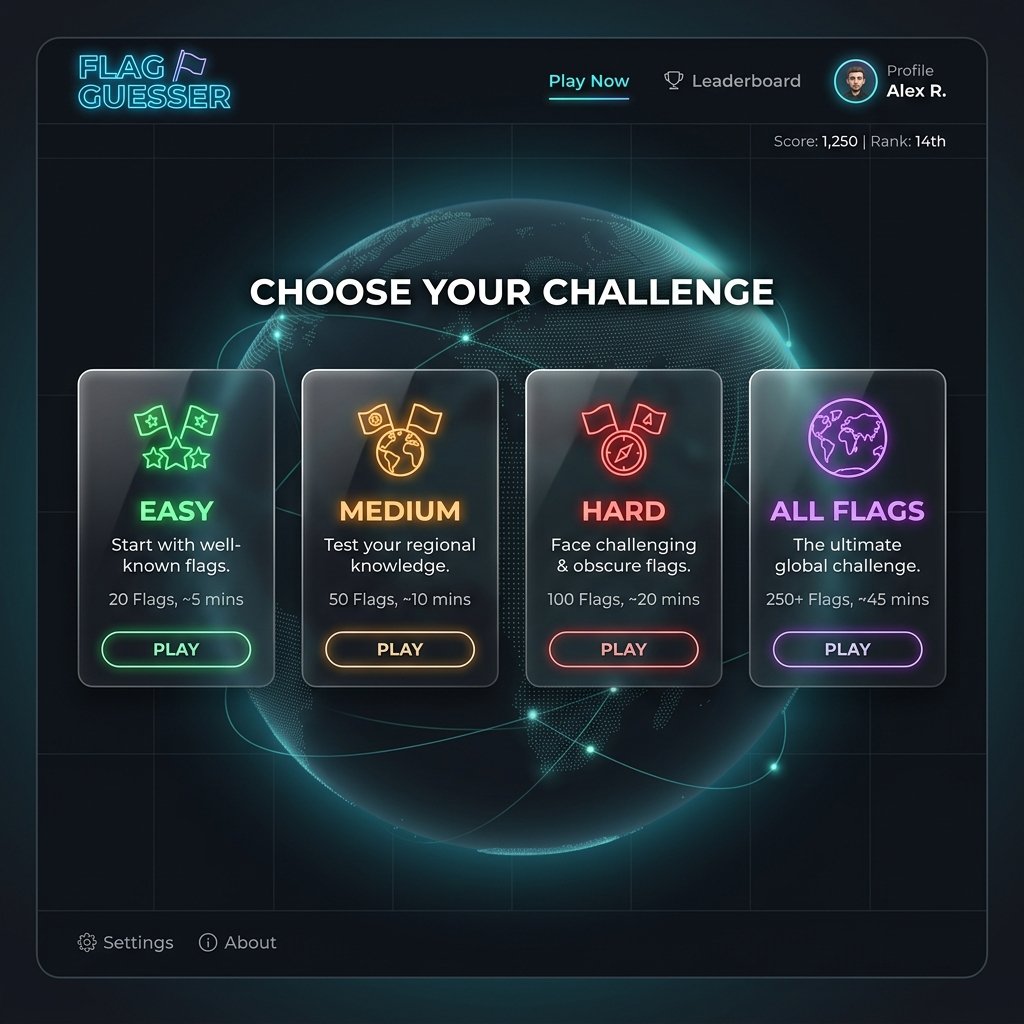
You are in total control of your learning curve. Easy Mode focuses on highly recognizable G20 nations (like the USA, UK, and Japan). Medium Mode introduces regional powers and well-known developing nations. Hard Mode strips away the familiar, testing you on obscure microstates and island nations. Or, choose All Flags for true chaos.
The Relentless Timer
Knowledge without speed is just trivia; knowledge with speed is mastery. Depending on your chosen difficulty, you have between 10 and 20 seconds to make your choice. The faster you answer, the higher your time-bonus points. Hesitation will literally cost you your high score.
The 3-Lives System
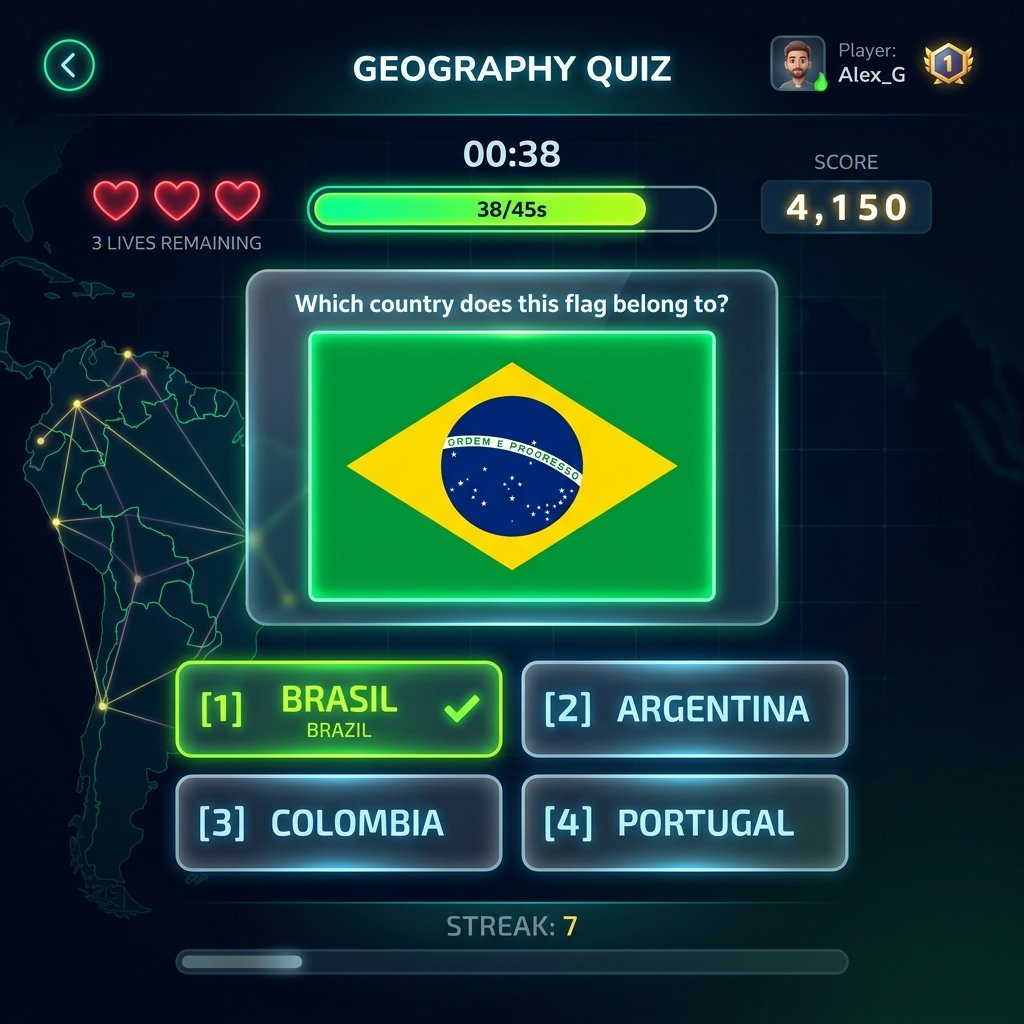
We heavily discourage blind guessing. You are given exactly 3 lives (represented by hearts in the top HUD) to survive a 10-round gauntlet. Make a mistake, and a heart shatters. Lose all three, and your run is unceremoniously terminated before you even reach the 10th round.
Streaks & Post-Game Analytics
Stringing together correct answers builds a multiplier streak that sets your score on fire. Once the game ends, you aren't just given a number; you receive a comprehensive breakdown of which flags you nailed and which ones ended your run, allowing you to study your weak points.
Sleek, Distraction-Free Design
As seen in the menu interface on the left, we've stripped away the chaotic ads and pop-ups that plague most trivia sites. The glass-morphism cards, glowing hover effects, and distinct color-coding for difficulties (Green for Easy, Red for Hard) are intentionally designed to get you into the action in a single click.
Notice the subtle rules breakdown at the bottom—everything is completely transparent before you even start your first round.
The Cognitive Science of Flag Memorization
Why does gamification work so well for geography? It all comes down to the science of pattern recognition. Flags are fundamentally graphic design systems. They utilize distinct color palettes, geometric proportions, and symbolic heraldry. When you play a fast-paced flag guesser, your brain is actively building neural pathways that link visual stimuli (like a tricolor pattern or a specific star arrangement) directly to geographic locations and names.
According to memory champions, spaced repetition and active recall are the most effective ways to move geographic knowledge from short-term to long-term memory. When the timer is ticking down and you are forced to recall if a flag belongs to Mali or Guinea, that moment of cognitive strain is exactly when the memory is permanently forged. If you want to dive deeper into the psychology of spatial memory, check out our expert blog articles.
High-Pressure Decision Making
The gameplay screen is engineered for maximum focus. The flag is displayed in high-resolution, uncropped glory, ensuring you can see every minute detail—from the intricate coat of arms of Spain to the exact constellation on Brazil's flag.
The top HUD constantly reminds you of your mortality: the depleting timer bar, your remaining hearts, and your active streak multiplier. The multiple-choice layout below is dynamically generated to include 'distractor' answers—countries from the same continent or with similar names, forcing you to truly know the answer rather than guessing by elimination.
The "Impossible" Flags: Expert Level Differentiation
Even seasoned geography buffs stumble when presented with these near-identical flags. Here is how the experts tell them apart under extreme time pressure:
Chad vs. Romania
They are virtually identical blue, yellow, and red vertical tricolors. The only difference? Chad's blue stripe is a slightly deeper, darker shade of indigo compared to Romania's cobalt blue.
Indonesia vs. Monaco
Both feature a red horizontal stripe over a white one. The difference lies strictly in the proportions: Monaco's flag is squarer (4:5 ratio), while Indonesia's is wider (2:3 ratio).
Australia vs. NZ
Both feature the Union Jack and the Southern Cross constellation on a blue field. New Zealand has four red stars with white borders, while Australia has six white stars (including the large Commonwealth Star).
Ireland vs. Ivory Coast
Ireland is Green, White, and Orange (from left to right). Ivory Coast is the exact reverse: Orange, White, and Green. Always check the hoist side!
Classroom Integration & Beyond
Educators worldwide utilize World Guesser's Flag Guesser as an interactive warm-up activity for geography and social studies classes. By gamifying the learning process, students develop an intrinsic motivation to study world maps, leading to vastly improved geopolitical literacy. There is a palpable excitement when a student correctly identifies the flag of Bhutan purely from memory!
Ready for a different kind of challenge? Once you've mastered the flags of the world, put your historical intuition to the test. Step into the past and try to deduce the exact year a photograph was taken with our incredibly popular Time Guessr mode!
Frequently Asked Questions (FAQ)
How many country flags are included in the game?
Our database includes all 195 officially recognized sovereign nations by the United Nations. Playing on 'Hard' or 'All Flags' guarantees you will encounter every single one of them eventually, ensuring a complete educational experience.
Exactly how does the scoring system calculate my points?
Points are aggressively weighted toward speed and accuracy. You receive a flat 500 points for a correct answer. However, we add a time bonus: remaining seconds multiplied by 30. If you answer in 1 second, your score skyrockets compared to answering at the last second.
Is this tool free for schools and educators to use?
Absolutely. World Guesser is staunchly committed to accessible education. There are zero paywalls, no premium subscriptions, and no invasive registration screens required to play. You can project it on a smartboard instantly.
Can I play Flag Guesser on my mobile device?
Yes! The UI has been heavily optimized for touch devices. The large selection buttons, highly readable text, and dynamic vertical layout make it perfect for playing on a smartphone during your commute.
What happens if I lose all 3 of my lives?
If you answer incorrectly three times before reaching round 10, the game immediately ends and you are sent to the Game Over screen. You'll keep the points you earned up to that round, but you forfeit the chance for a 10-round perfect score.
Why did you include fun facts in the game?
We believe contextual learning is key. By clicking the "Show Fun Fact" button after a correct guess, you learn a unique piece of cultural or historical trivia about the country, reinforcing the memory of the flag you just identified.
How does the difficulty selection actually work?
The algorithm filters the pool of 195 countries based on global recognition metrics. 'Easy' only pulls from the top 50 most famous flags. 'Medium' adds regional powers. 'Hard' includes the most obscure microstates and island nations on Earth.
What is the best strategy to get better at recognizing flags?
Start by learning the flags by continent or by specific vexillological families (like the Nordic Crosses or Pan-African colors). Play on 'Easy' until you achieve a perfect score consistently, then graduate to 'Medium'. Consistency is key!